5 Billion Views in 5 Hours: Uncovering the Traffic Bubble Behind AI Short Dramas
5 Billion Views in 5 Hours: Uncovering the Traffic Bubble Behind AI Short Dramas
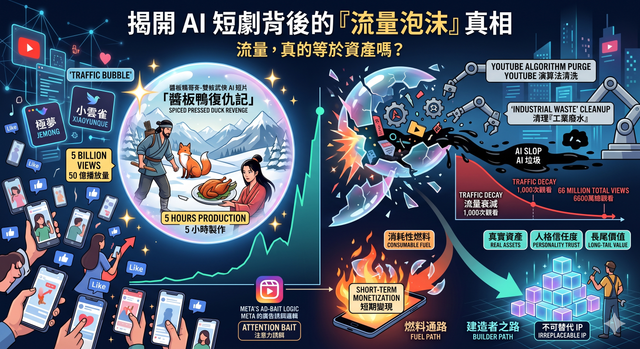
In the current digital content battlefield, a productivity revolution driven by artificial intelligence is completely changing the rules of the game. In early 2026, an AI short film titled "The Revenge of the Sauce Duck" went viral across major social platforms. The story was absurd: a woodcutter saved a fox on a snowy mountain, but was left with a "sauce duck." Years later, a woman came to his door, claiming she was not the fox, but the sauce duck seeking revenge. Combined with a strong AI-generated martial arts aesthetic, the hashtag for the video amassed an astonishing 5 billion views within a month.
However, the most shocking aspect behind this carnival was not the plot, but its production cost: the original creator used AI generation tools like Jimeng and Xiaoyunque to complete the short film in just about 5 hours. Five hours of labor exchanged for 5 billion exposures—this is undoubtedly the most extreme success story of "zero trial-and-error cost" in content creation. But when we strip away this glamorous data exterior, the truly severe problem emerges: does traffic really equal an asset?
The Traffic Laboratory: Compressed Content Production Cycles
In the past, the essence of film, television, or high-quality video content was "high cost, low frequency, and heavy bets." Every release involved actors, scenes, shooting teams, and massive budgets. But with the intervention of AI Workflows, the content industry is rapidly moving towards extreme industrialization. What AI has significantly reduced is not the production quality, but the "cost of trial and error."
Creators can now rapidly generate characters, switch languages, and conduct multi-version A/B testing. This model is exactly the same as the logic behind past internet advertising (Playable Ads): instead of spending months crafting a "masterpiece," creators use an extremely high frequency to test which emotion brings higher Retention and Click-Through Rates (CTR). Technology and content are no longer the ultimate goals here; they have become experimental weapons to acquire traffic.
The Decay Curve: Why Are 60 Million Views Worthless?
Let's turn our attention to the second half of this craze. On YouTube, many channels dedicated to re-uploading or imitating these kinds of AI short dramas have sprung up like mushrooms. Take a channel that massively re-uploaded "Sauce Duck" related AI videos as an example; the channel accumulated over 2,400 videos and a total of 66 million views. These seemingly impressive results mask a fatal fact: the view count for its recent individual videos has plummeted to around 1,000.
This steep decay curve perfectly proves one thing—traffic is not an asset. When the hype fades, these channels, relying on high-frequency mass production and re-uploading, lack original perspectives, have no recognizable personality, and cannot build reader trust. Audience attention is fleeting; they chase stimulation, not the creator themselves. For these channel owners, the massive view data is ultimately just a fragile traffic bubble.
Platform Backlash: When Algorithms Start Cleaning Up "Industrial Waste"
What's more terrifying than losing the audience is the ruthless ban from distribution channels. In early 2026, YouTube initiated a massive purge of low-quality, repetitive AI content. Many channels relying on synthetic voice and heavily templated scripts were canceled or suspended overnight, losing tens of millions of subscriptions and seeing potential ad revenue instantly drop to zero.
This indicates that the platforms' AI detection systems are now capable of accurately identifying these soulless "content farms." YouTube's business model relies on the long-term health of the creator ecosystem, so it must step in to stop this "AI Slop" that ruins user experience. When content is deemed inauthentic or highly repetitive, the algorithm won't even give it a chance to be pushed. You might think you are using the platform to earn traffic, but in reality, the platform is using algorithms to determine your survival.
Meta's Double-Edged Sword: Different Business Logics
Interestingly, the exact same content might have a completely different fate on short video platforms like Facebook Reels. Because Meta's core business model heavily relies on ad displays, AI-generated content happens to provide the lowest-cost, infinitely supplied attention bait. As long as these short videos can keep users staying and scrolling, the platform has no strong incentive to ban them entirely.
But for Creators/Builders genuinely dedicated to crafting in-depth content, this means the competitive environment is even harsher. High-quality, long-form articles or deep analyses must compete for the same audience's attention against these three-second plot-twist AI short dramas, and the algorithm will not proactively help you filter out this noise.
Conclusion: Will You Be Fuel, or a Builder?
The AI era is opening up a massive chasm between two worldviews: one is throwing oneself into a high-speed traffic experimentation factory, pursuing extreme ROI and short-term monetization, becoming consumable fuel; the other is using AI to amplify one's own productivity to slowly build "real assets" with irreplaceability, personal trust, and long-tail value.
The viral success of the "Sauce Duck" was a spectacular internet event, but it can never become a sustainable IP legacy. Today, as AI tools become increasingly powerful and content generation costs plummet, the most important question we should ask ourselves is not "How can I use AI to generate more traffic?" but rather, "When the tide recedes, what have I left behind?"
Reference Sources:
1. 2026 Digital Content Industry and Algorithm Evolution Observation Report (Social Network Trend Analysis)
2. YouTube Creator Blog: 2026 Update on Guidelines for Synthetic and Altered Content
3. In-depth Commentary on Technology and Creator Economy: The New Species in the AI Era
Frequently Asked Questions
- Can AI-generated short dramas or videos still serve as long-term monetization tools?
- It is becoming increasingly difficult. While they can attract eyeballs and create astonishing traffic in the short term, as audience thresholds rise and platforms (like YouTube) strictly review and purge highly repetitive AI content, videos that are purely re-uploaded, templated, or mass-produced at low quality can no longer form stable, long-term content assets.
- Why is there such a huge difference in reach and treatment for AI-generated content on Facebook versus YouTube?
- It depends heavily on the platform's business model. YouTube values the long-term health of its creator ecosystem and proactively cracks down on AI content deemed invalid or "industrial waste." In contrast, Facebook's (Meta's) short videos currently lean towards maximizing user attention and watch time to sell ads, resulting in a higher tolerance for high-frequency mass-produced AI content that can retain eyeballs.